Version 0.2.4, released 2026-11-23. Changelog
KyPanel Install

Account isolation and security

A shared server runs code written by many people. This page describes what keeps one hosting account away from the others and from the server, and how the panel protects itself.

Accounts

Linux user
Each hosting account is a separate Linux user, and everything it runs runs as that user.
PHP
A PHP-FPM pool per account and per PHP version, started on demand.
Filesystem
The account's PHP, CGI, apps, deploys, cron jobs and jailed shell run in a filesystem of their own: /home holds only the account's home, /etc holds only what programs need, and the user list has only root and the account. /usr is read-only.
Home folders
Other accounts can't list or read a home folder. The web server only reaches what it serves.
Limits
A cgroup (v2) per account caps CPU, memory, disk I/O, processes and concurrent PHP requests, as set by its package. Disk quotas count files, mail and databases.
Databases
Names and users carry the account's prefix, and the panel never lets an account touch another prefix.
Mail
Hourly sending limits per account, with automatic holds on bulk sending. Optionally, only the mail server and root may connect to SMTP ports on other servers.

The shared web server

The accounts' sites share nginx and Apache, so the web server is held to the account too:

  • Options lines in .htaccess are ignored, with a warning in the log, and the site keeps working.
  • Symbolic links are followed only to the account's own files.
  • A PHP request runs only the account's own scripts.
  • PHP, CGI and apps can't create kernel namespaces or reach the cloud provider's metadata service.

These rules came with version 0.2.3, which fixed a way for one account to reach another through the shared web server. The details are in the changelog.

SELinux and AppArmor

On AlmaLinux, Rocky Linux and CloudLinux, SELinux stays enforcing. KyPanel installs its own policy modules for what it adds (the per-account PHP pools, the jailed shell, CGI and the browser terminal), so nothing it adds runs unconfined. On Ubuntu, AppArmor's default profiles apply.

The panel

Two processes
kyd serves the panels and the API as an unprivileged user. kyd-agent is the only part that runs as root, and it accepts a fixed list of operations with validated arguments over a local socket.
Secrets
API tokens, webhook and backup credentials and Cloudflare tokens are stored encrypted with the server's master key. Passwords and API tokens are kept only as hashes.
Sessions
HttpOnly, Secure and SameSite cookies, a CSRF token on every change, idle and absolute timeouts.
Separate ports
Webmail and phpMyAdmin run on their own ports and in their own PHP pools, apart from the panel.
Audit log
Every change in the panels or the API is recorded with who made it, from where and through what.

Logins

Brute force
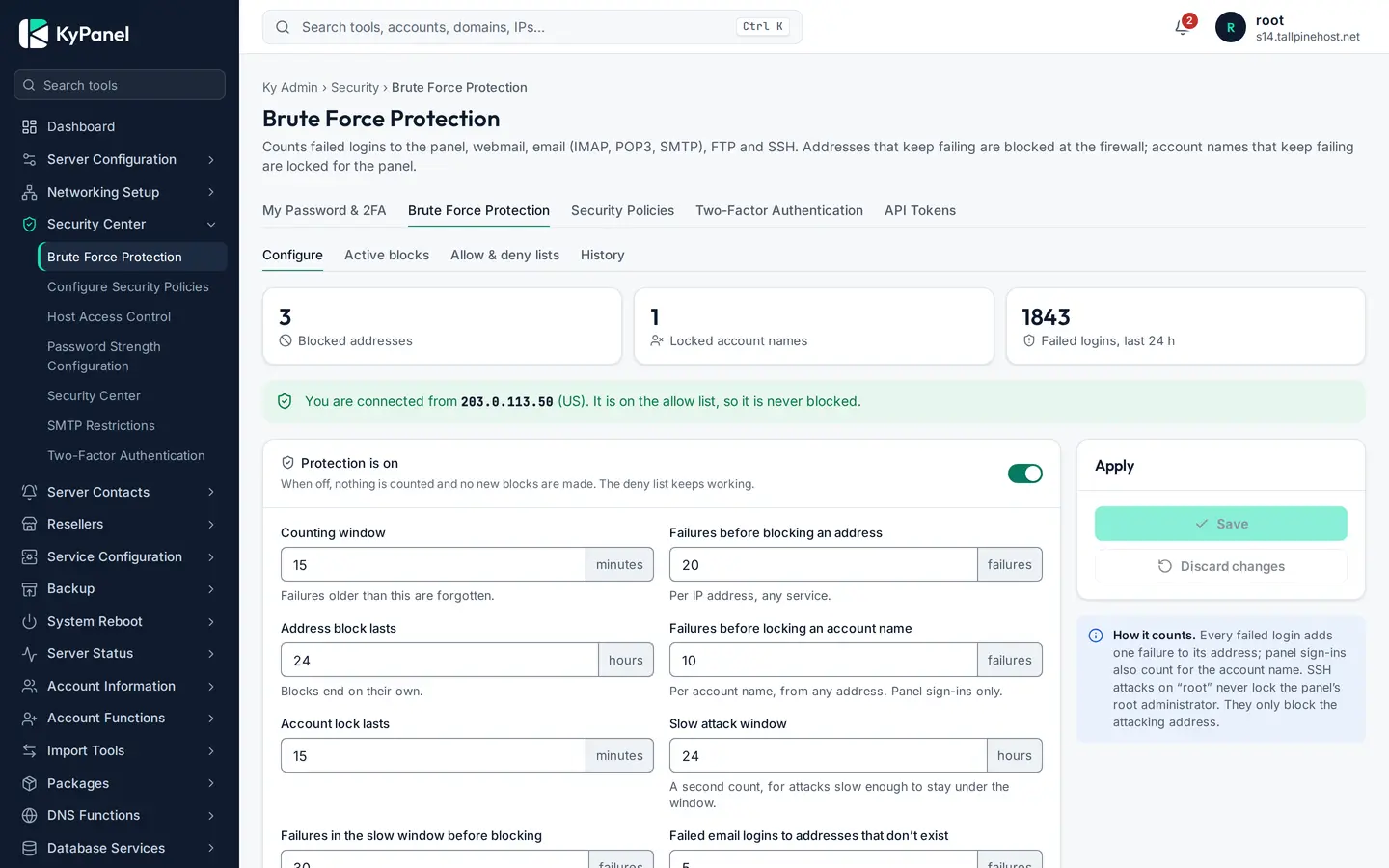
Failed logins to the panel, webmail, mail, FTP and SSH are counted on the server and its nodes. An address that keeps failing is blocked at the firewall, and a second count catches slow attacks over 24 hours.
WordPress
Password guessing against wp-login.php and xmlrpc.php is rate limited per IP before PHP starts.
Two-factor
Authenticator apps and recovery codes for admins and customers. You can require it for either.
Admin access
An allow list of IPs for signing in to Ky Admin, and IP limits and expiry on API tokens.
Firewall
Open ports listed and managed in the panel, each one limited to chosen addresses if you want.
Brute Force Protection settings in Ky Admin
Brute Force Protection.

Updates

Releases are signed with Ed25519 and checked before they install, and each package is checked against its SHA-256. An update rolls back if the panel doesn't answer afterwards. The operating system gets security updates every day, and servers check for KyPanel security advisories every 15 minutes.

Reporting a vulnerability

Write to support@kypanel.com with "Security" at the start of the subject. The message becomes a private ticket that only KyPanel staff can read. Include the version, what an attacker can do and the steps to reproduce it. Each fix is listed under Security in the changelog, in the release that fixes it.